Showing posts with label induction. Show all posts

Monday, July 4, 2011

Cooking Green! And We Don't Mean Green Meat

Blog Week of July 3rd

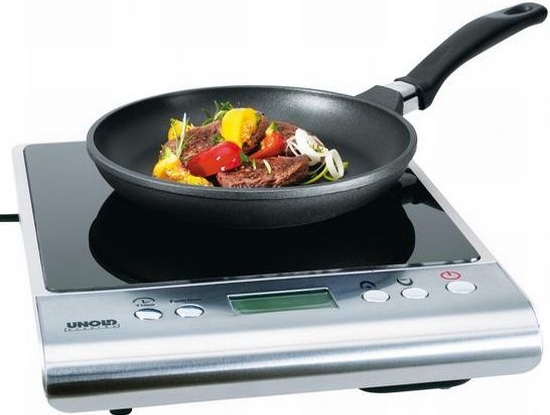
Remember that old adage, ‘if you can’t take the heat, get out the kitchen?’ Now it’s, ‘if you can’t take the heat, just get an induction burner!’

We all remember that old saying, “If you can’t take the heat, then get out of the kitchen?” Although often applied to real life situations, there is certainly a literal sense to the meaning. With summer in full bloom, the sun is shinin’ bright and that means it time to get together for family gatherings – most likely in the form of outdoor BBQ’s. But it’s hotter than ever outside making it both difficult and inconvenient and all the massive heat that comes from both gas and electric stoves makes this experience that much more dreadful. 

If you are like me, you have probably wondered if there were easier ways to enjoy cooking without all of the extra heat! Cooking without the extra heat is something that is unknown to the average American but now there is a way. 

General Electronics stated in a press release, “Although popular in European and Asian households and among professional chefs worldwide, induction cooking is still largely a mystery for many North American consumers.” With induction cooking, a current is produced when a steel or iron bottom pan is placed on the cook top, which has an electromagnetic element under its smooth surface. The current passes through the cook top and heats the pan and cooks the food inside. Nearly all the energy is transferred directly to the magnetic cookware and the food, making induction cooking quick and efficient. Because there is no residual heat from burners, cooking adjustments are nearly instantaneous and precise.” 

Essentially, all the heat is transferred to the actual pan and not the cooking surface. This provides a safer alternative as well as because no heat is transferred to a nonferrous object such as plastic, paper, cloth, or even a hand that touches the cooking area! This in turn creates a cooler and safer cooking environment that is also easy to clean.

The advent of new technologies is now allowing us a greener and cleaner way to do everyday things like cooking. So get ready for July 4th, put on your new summer outfit, and take the fun outdoors!

One Stop Green is looking towards a ‘greener’ future, sharing the latest and greatest ideas in green living and green technology with you through our staff written blogs. Going 'green' is no longer a choice, it's our responsibility, that's why it's so important to try and do the small things that can help change the outlook of the planet - and this is essentially the purpose of One Stop Green. We believe even the little things like recycling or using less water helps the environment out in a big way, and that's why our various solutions seek to nurture and edify your home or business in an eco-friendly manner.

Visit our website at www.onestopgreen.com or download the mobile app at http://fwd4.me/01gP


Keywords: induction cooking, green cooking, green cookware, cooking easy, no heat, innovative cooking, eco-friendly cooking, july 4th cooking, cooking with less heat

Wednesday, June 15, 2011

The End of Incandescents - How to Keep the Lights On

Blog Week of June 5th

The end of the Incandescent bulb is just the Beginning of the Future…

The end of the incandescent bulb as we know it is near thanks to a law signed by former President George W. Bush in 2007.  While not banning the bulbs outright, the law requires incandescent bulbs to be 25% more efficient and dictates a phase-out of inefficient bulbs beginning in January 2012.

The 100-watt incandescent bulbs will be some of the first to go and as rolling deadlines between 2012 and 2014 come and go, more of their incandescent brethren will join them.  While the law doesn’t require the use of compact fluorescent (CFL) bulbs, it will however slowly phase it out, giving compact fluorescents (CFL’s) and Light Emitting Diodes (LED’s) a leg-up in the marketplace.

Now, to clarify, this new law by no means outlaws incandescent bulbs outright.  It does however, mandate more efficient incandescent bulbs, which essentially means a phase-out of current models.  In fact, the National Electrical Manufacturers Association, a trade group representing light bulb manufacturers, has cited a new 72-watt replacement for traditional 100-watt bulbs.

Unfortunately, this has not curbed hoarding of current bulbs.  In a New York Times article, anyone from home decorators to restaurateurs to everyday citizens said they would buy their favorite bulbs in bulk from wherever they could be found.  At the lighting industry trade show, Lightfair, Philips unveiled a $40-50 LED bulb with a 25,000 hour lifespan and conservative personalities like Glenn Beck and Rush Limbaugh jumped on the fact that our government was banning current incandescent bulbs for $50 replacements (The Associated Press reported a $50 price tag and Fox News picked up their story spinning it as “As Government Bans Regular Light Bulbs, LED Replacements Will Cost $50 Each”).

On the upside for LED lighting, the future is only getting brighter.  While CFLs are considered the main alternative to incandescent lighting, they do have some negatives.  The biggest issue is that CFL bulbs contain mercury, making cleaning up a broken one a potentially dangerous proposition.  Some CFL’s also require a “warm up” period like the large halogen lights at your favorite sports stadium.  CFL’s are also more expensive than incandescent bulbs, however the energy savings make up for that after about 6 months.  And while CFLs last longer than incandescent bulbs, sometimes they don’t live up to their advertised expectations – so be sure to buy from a manufacturer who offers a limited warranty.

So why LED lighting?  The biggest plus is that their color better emulates incandescent bulbs and they outlast even CFL bulbs (by nearly ten times).  The technology behind LED lighting is the same semiconductors that are used in cell phones and computers, so as they improve, so does LED lighting.  LED’s are also gaining the backing of name-brand manufacturers, like Philips and Sylvania, and retailers like Home Depot and Lowe’s are now making them available in their stores.

For now, the advantages of LED lighting don’t counter the up front cost, so CFL bulbs are the better recommendation.  However, as technology improves and costs fall, LED lights are soon to become what the CFL became to the incandescent bulb – a game changer. In another decade or even less, CFLs could be phased out due to mercury issues leaving LED lights as our primary option.

If you are looking to go green and get rid of your incandescent lighting, One Stop Green carries both CFL and LED lighting options for nearly any application.  One Stop Green recently partnered with Earthmate Lighting to carry some of the smallest and greenest (down to the packaging) CFLs on the market.  One Stop Green’s LED lighting is made for residential and commercial applications as well and while more expensive that CFLs, LED lighting is even more energy efficient and emulates the incandescent lighting many people miss.

One Stop Green is looking towards a ‘greener’ future, sharing the latest and greatest ideas in green living and green technology with you through our staff written blogs. Going 'green' is no longer a choice, it's our responsibility, that's why it's so important to try and do the small things that can help change the outlook of the planet - and this is essentially the purpose of One Stop Green. We believe even the little things like recycling or using less water helps the environment out in a big way, and that's why our various solutions seek to nurture and edify your home or business in an eco-friendly manner. 

Visit our website at www.onestopgreen.com or download the mobile app at http://fwd4.me/01gP